Dear Friends and Colleagues of L.A. Louver:
On Thursday, June 11, our dear friend David Hockney died, peacefully, at home, in London.
At the time, my wife Liz and I were attending the opening concert of the Ojai Music Festival arranged by Esa-Pekka Salonen, a favorite conductor and friend of David’s, especially following his unwavering support of Frank Gehry and their formation of Disney Hall.
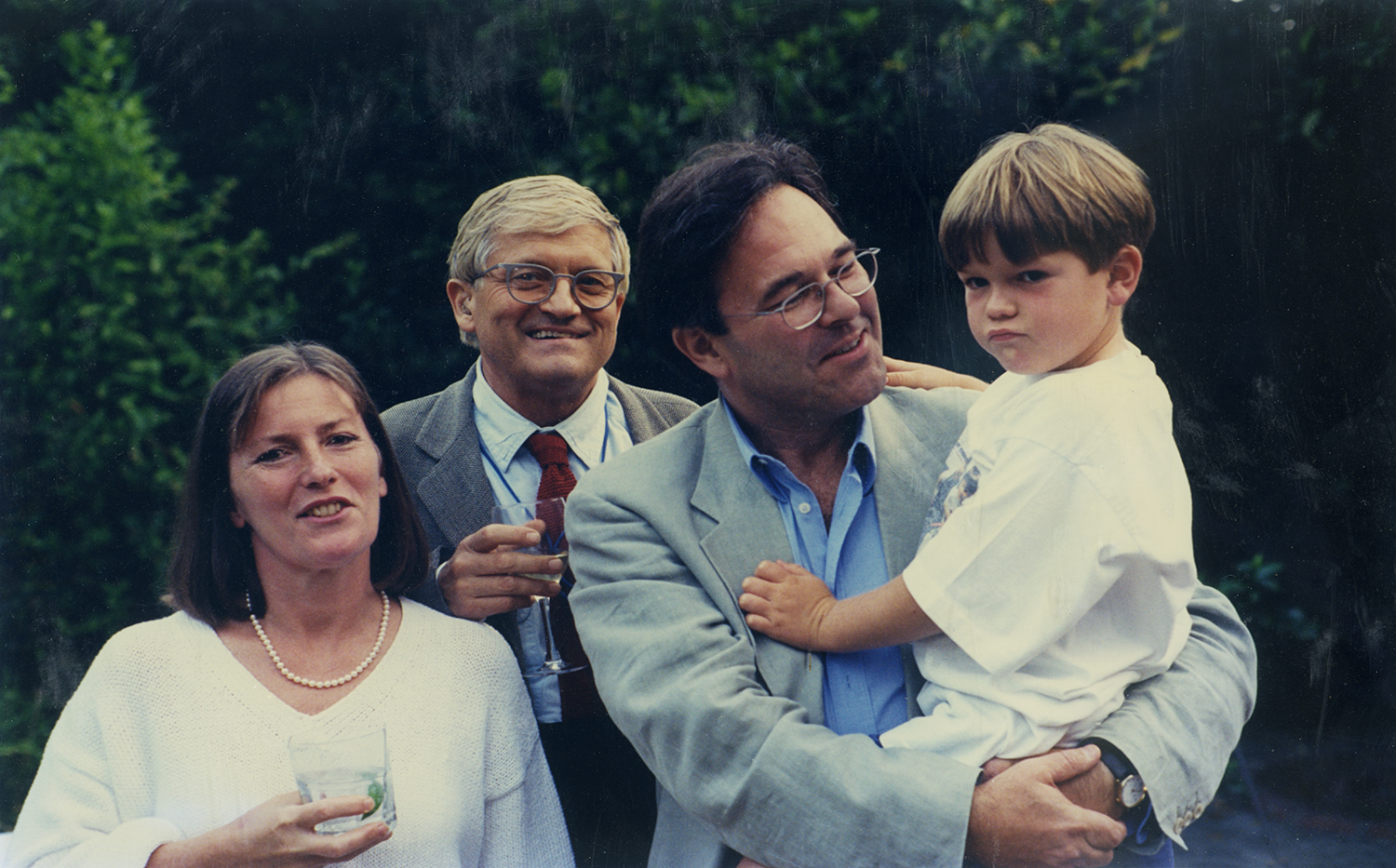
We were first alerted of David’s passing by our son Oliver the following Friday morning – David being the first person to have met Oliver when he came home with Liz from hospital.
Since then, we have been overwhelmed by articles and notices from the UK and around the world, all describing in immense detail and through a variety of personal descriptions and historical outlines the important and unique artistic, cultural and scholarly contributions David Hockney made through the course of his amazing life and experiences. The mountains of tributes culminated in the brilliant Financial Times obituary by Jackie Wullschlager, who was David’s favorite biographer, art critic and historian. As such, plenty has already been written for you to be able to contextualize David’s creative life
Following almost four weeks of feeling in a void, I have returned to work, as David would have wanted.
Perhaps it will be of interest to our readership for me to answer a few questions which have arisen over the course of our more than 48 years of professional and personal relationship.
At the early age of nine, David knew that he would become an artist. For most of the great artists I have been privileged to represent or work with, this has been a unifying element in their development. If his mother had permitted it, David would have attended his local art school when he was 14. Instead, he enrolled at Bradford School of Art at 16 years of age. The advantage of an earlier start at art school gave us all at least seven years in college, leading David to his extraordinary journey.
Liz and I were art students at 16 years of age at Walthamstow School of Art, where the artist Peter Blake and director Ken Russell taught occasionally, where Celia Birtwell tutored and Derek Boshier also studied and lectured.
I actually met David for the first time in 1968 when he was invited for a talk at my second college, Coventry School of Art, where Art & Language was founded. He spoke to my colleagues about the formation of his career. It was an inspiring presentation – joyful, playful, and very much about being from that age – from which I learned a great deal and harvested my confidence to continue on my path.
Later at The Roundhouse in Camden, David and I both happened to attend the Coldstream Hearings on the transformation of art education away from a form of “vocational trade” studies, with art schools throughout local districts in the UK, to a formal academic pursuit. At that time, William Coldstream was the Principal of the Slade School of Art. During the two days of hearings, David sported a pocketful of different colored eyeglasses, which he kept changing as a playful distraction from otherwise boring proceedings. He became further renowned for his snappy style of dress, which he inherited from his eccentric father, who was self-conscious about his appearance, along with a fascination for gadgetry of all kinds, cameras and taking photographs, reading, and music performed in the neighboring city’s music hall.
Liz already knew that she would become a textile designer, and I chose to drop out of school earlier than at the traditional 18 years’ crossroads, driven by my documentarian obsessions and the desire to learn about the audiovisual world. I received the Leverhulme Fellowship Award for 1971, an annual postgraduate acknowledgement, for which I was selected to represent Manchester School of Art and Advanced Studies, affiliated with Manchester University. Subsequently, I was recruited in 1972 to teach various classes in the Department of Art at UCLA, where David had previously been hired to be a visiting lecturer during the summer of 1966. (It was later in 1970-1971 when R.B. Kitaj was also employed by UCLA as a lecturer.)
Liz and I founded L.A. Louver Gallery in 1975, and we opened to the public on North Venice Boulevard in Venice Beach in 1976.
Between 1977 and 1978, I independently commenced assembling at least one copy of every graphic work David had produced from his time at Bradford School of Art in the mid-1950s prior to moving to London and attending the Royal College of Art in the late 1950s and early 1960s.
In 1978, David revisited Los Angeles for a more “permanent” stay, and learned of our early gallery endeavors, whereupon he called for a meeting. Fortunately, all of his graphic works were at L.A. Louver, being readied for framing when David, ever punctual as I was to learn, showed up for his appointment at 2 p.m. We talked for several hours about each work, and he offered to be of assistance. Such a radiant personality emerged, as did gratefulness for what would prove to be a “Welcome Back to Los Angeles” exhibition – so much so, that David invited us to select a group of current drawings to complete the show, which Liz and I did the following day at his new “transitional” home in L.A.
Our first exhibition together, David Hockney: Drawings & Prints, 1961-1977, was a rousing success, and L.A. Louver’s contribution to Los Angeles was now underway: To exhibit local artists in an international context, and to introduce global artists to a Southern California audience.
In many ways, David helped us establish our gallery’s thesis and ethos.
Following this first exhibition, L.A. Louver has had the privilege of mounting 25 solo exhibitions of David’s work, together with 29 group exhibitions into which his work was contextualized along with other local and international artists.
We have been the beneficiaries of David’s decades of living in and loving Los Angeles. Beyond visiting his studio on Santa Monica Boulevard in West Hollywood, I made frequent visits, often several times a week, to David’s new home and studio on Montcalm in the Hollywood Hills, which he acquired and developed in the late 1970s and early 1980s.
So it followed that we had the opportunity to meet numerous, fascinating visitors to Montcalm, and during the many trips David and I made together to exhibitions and music production venues around the world. From this vantage point, we indirectly became members of DH’s team and traveled to almost all of his subsequent exhibitions and projects. For example, Mickey and Martin Friedman initiated a touring exhibition of David’s work in theater, which opened at the Walker Art Center in Minneapolis in 1984, and travelled internationally to seven venues. I learned so much from these experiences; for example, how exhibitions can be adapted to the uniqueness of each museum’s space. Kimberly Davis joined L.A. Louver as a Director in 1985, and David welcomed her and my other colleagues to his home and studios.
Major Hockney exhibitions materialized at LACMA (1988), in Boston (1998), Paris (1999), Australia (1999-2000), Bonn (2001), and London (2005, 2007, etc.), and other locations during this period, and David maintained a limitless generosity of spirit which he shared with the various teams of colleagues he assembled, growing in number both in London and Los Angeles. We also supported David through numerous gallery exhibitions with colleagues in London, New York, Paris, and Chicago.
The 1999 trip with David to Australia was especially memorable as we were celebrating the National Gallery of Australia’s acquisition of A Bigger Grand Canyon, 1998, together with a gift to the museum of a number of study drawings for the making of this very important painting. Due to the massive 17 to 19-hour time change and jet lag, I found myself reading each day David’s latest draft of Secret Knowledge, which was heading to the publisher for its deadline. David’s curiosity, courage and challenges to art historical canon and convention fed these conversations and exchange. On the occasion of the exhibition, Richard Alston, then Australia’s Minister of Communications, Information Technology and the Arts, made the main speech; he also wrote about the friendship he developed with David from this time in a recent edition of The Australian. I was seated in the company of Geoff Ainsworth, whose family are renowned, generous Australian philanthropists, and who have also supported the collections of NGA in Canberra and Art Gallery of New South Wales in Sydney. It was a thrilling trip, culminating in a family reunion in Sydney with David’s two brothers and their families who immigrated from England to Australia in the 1950s and 1960s. This time was also foundational to my enduring friendships with Richard and Geoff.
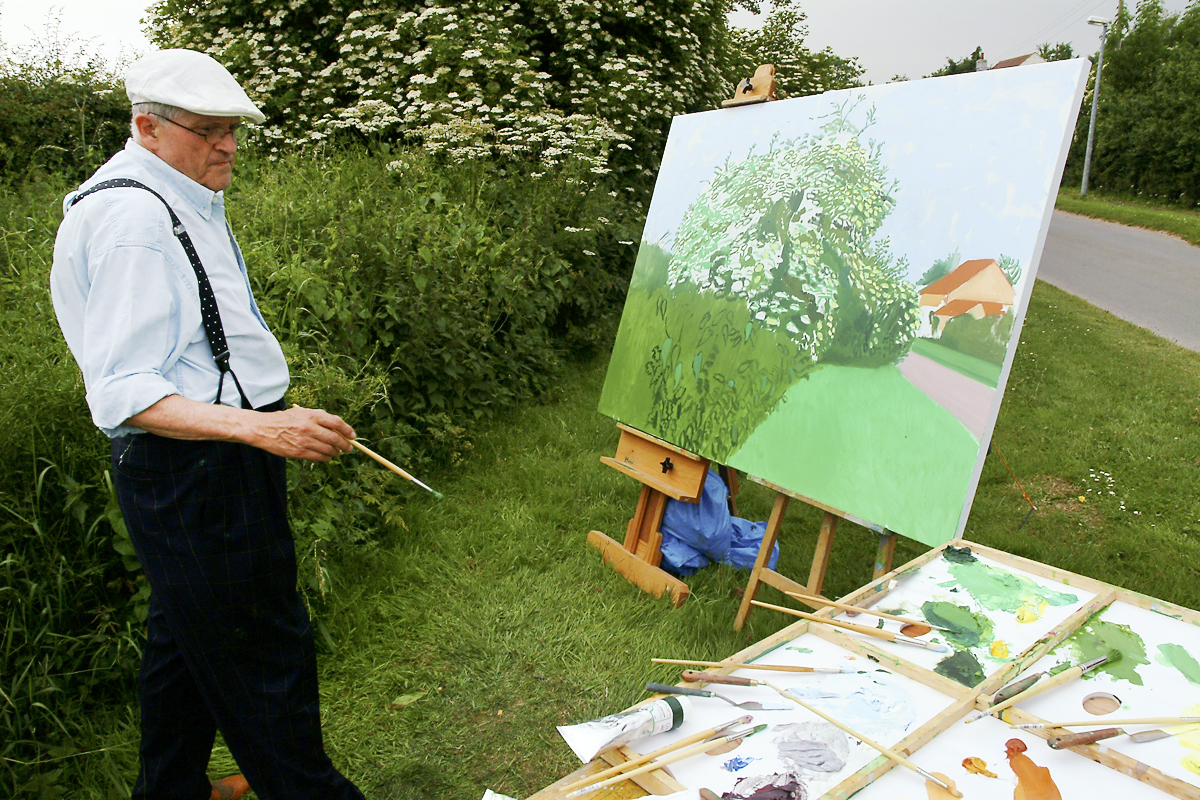
When David’s mother, his sister Margaret, and her companion Ken moved to the family holiday town of Bridlington in the late 1980s, frequent visits by DH followed – also to keep up with the deteriorating health of his dear friend Jonathan Silver, founder of Salts Mill in Bradford. It was really Jonathan who urged David to paint his impressions of the East Yorkshire landscape – leading to the plein air works, and to the Royal Academy’s all-spaces exhibition in 2012. My trips to join David in the East Yorkshire landscape from the late 1990s through 2013 provided special insight into his careful looking and how he expressed his observations of its seasons, nature and time in all media. David’s mother paid attention to religious values, and being in such proximity to nature’s cycles reached into David’s working life, and in turn, our discourse.
It was also special to encounter David’s new life, home, studio and landscape in Normandy, France, where he moved with his long-time partner Jean-Pierre Goncalves de Lima in 2019. From the mid-2000s, J.P. had become David’s main studio assistant, principal form of support, and David became his mentor, and later, his companion in life.
David’s work has been celebrated in ambitious contexts, including the 2017 Centre Pompidou retrospective, his triumphant 2025 exhibition that inhabited the entirety of Fondation Louis Vuitton’s Frank Gehry architecture, and followed on by David’s exceptional show in London at Serpentine Galleries this year.
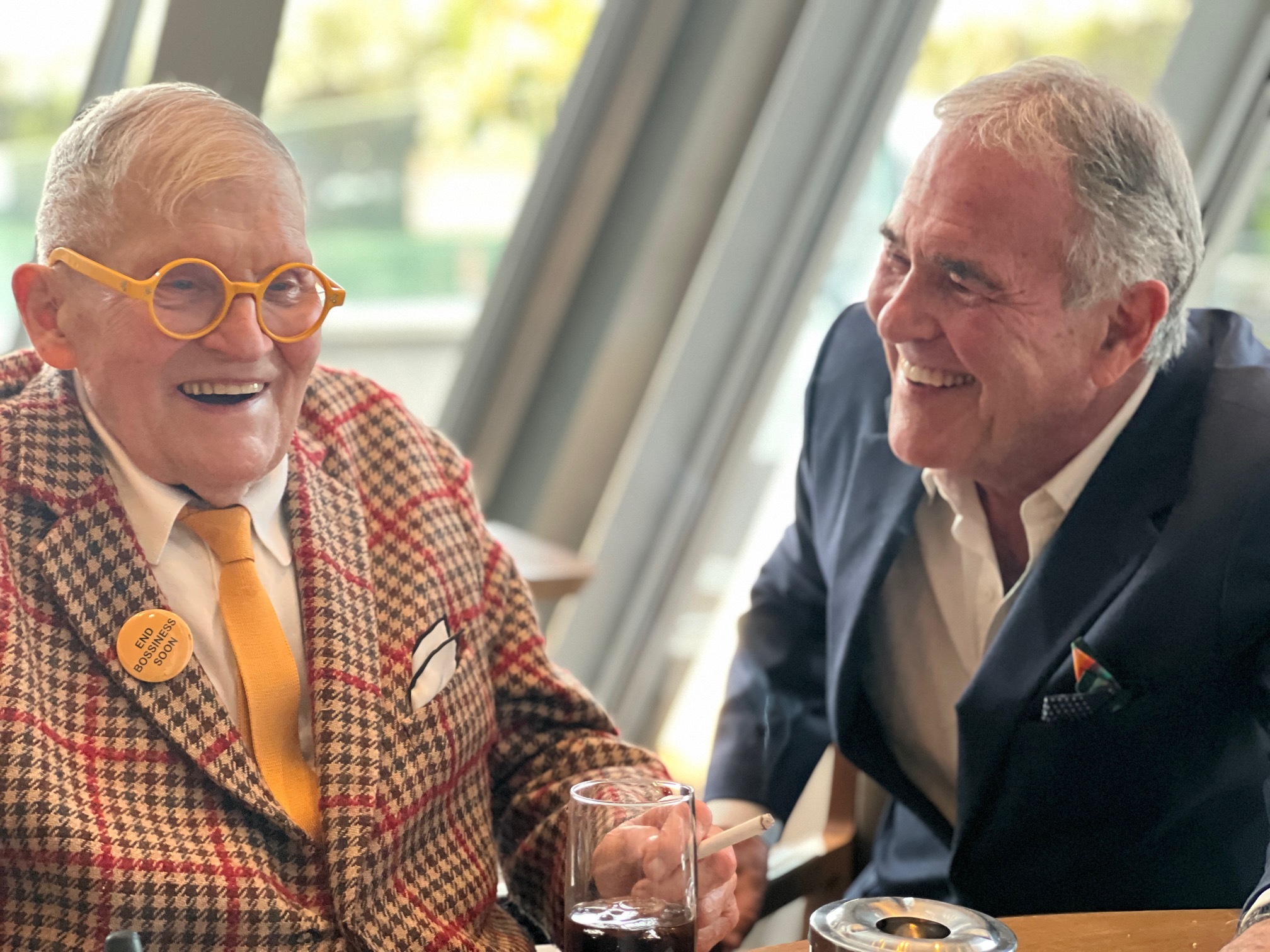
Another invaluable aspect of time spent with David, in his studios and particularly at Montcalm, was my introduction to his home library, which he had assembled from London, along with his personal papers and documentation. This was an extraordinary adjunct to David’s planning for opera and costume design activities, together with imagining a new direction rooted in art history, which would become his momentous book about artists’ use of optics, Secret Knowledge. His was not an encyclopedic library, but rather full of personal evolving interests around the subject, period and places of the theatrical productions, inspiring exhibition experiences, and recently published biographies.
We met often, discussing art history and referring to his books. I realized that from our discourse over several days revolving around David’s collection of Christian Zervos’ 33-volume catalogue raisonné in black and white all of Picasso’s life’s work to which one could subscribe. As David had, I followed suit.
Through the constant stream of David’s extremely interesting visitors, such as the philosopher Richard Wolheim, who also became a friend, and numerous curators and writers, so much could be learned from them and their personal libraries.
In this way, L.A. Louver’s Archive and Library began to take shape, and visitors to our holdings have profited from this insider insight. Our fascination in this area was later to be inspired by Ed and Nancy Kienholz, Leon Kossoff, R.B. Kitaj, Per Kirkeby, Georg Baselitz, and other artists who maintained documentation, books and archival material. In our case, we have been cultivating and organizing invaluable documentation from L.A. Louver’s activities from 1976-2025, including 667 gallery exhibitions and numerous museum exhibitions over this period, for the research interests of scholars, writers, curators and clients.
Technology was always a fascination of David’s, but it played an increasingly central role in his way of working, particularly once the iPhone, and subsequently the iPad, landed in his hands. Various close friends and groups of individuals became recipients of David’s visual and written experiments. This digital connection became especially vital as his hereditary deafness mounted, making it impossible for him to comfortably attend noisy gatherings or enjoy restaurant pleasures, even while traveling.
David and I continued our dialogue through FaceTime contact twice a week, and during studio visits to London. Sadly, we both knew after the Serpentine opening, which was also given a special private view for out-of-town visitors, that the end was nigh.
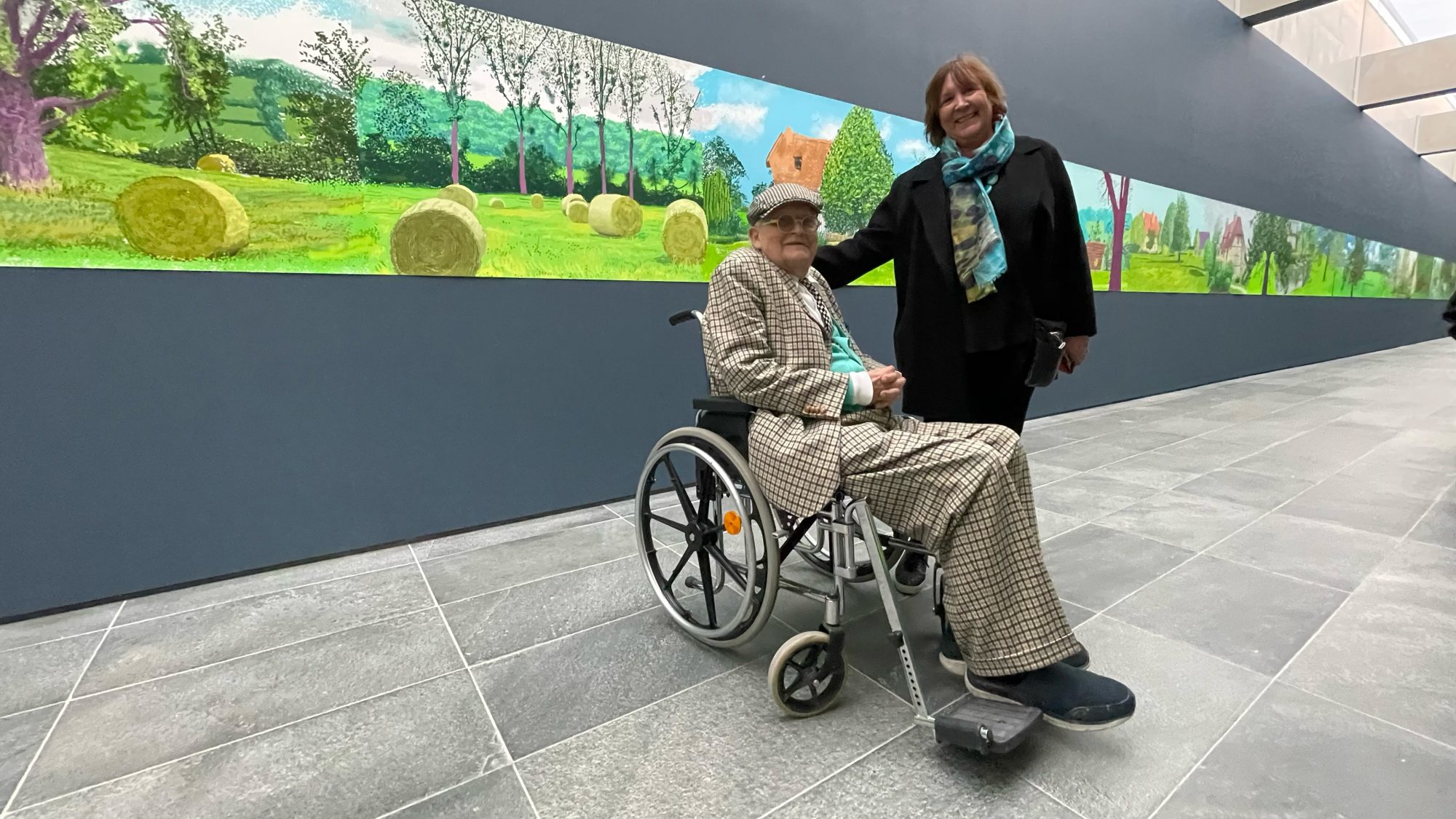
Our last FaceTime conversations were totally superb. David had realized that I had come to terms with the singularity of the Serpentine exhibition; it was really one piece. His study of the Normandy landscape and its seasons, the 90-meter-long work A Year in Normandy, 2020-2021, was his rendition of The Bayeux Tapestry and a reference to Chinese scroll painting. This work circumnavigated study-based portraits of David’s current London inner circle. The installation was also distinguished by David’s use of mirrors, which were always present in all of his studios, to challenge his compositional devices and check his sense of reverse perspective. Our dialogue was so intense, that he knew I had fully comprehended the curatorial purpose of the show; it was a narrative unto itself. This was his inner world, surrounded by this lineage of history. In this case, not a history of battles and 1066, but the battle of nature to embrace us all.
However, to my surprise, I was not prepared for what was to follow three weeks later.
After 48 years of devoted friendship, I could never have imagined a life without David.
Today, July 9, 2026, would have been David’s 89th birthday.
Peter Goulds
Founding Director
L.A. Louver
Venice, CA